
Let’s begin by addressing the semantic elephant in the stadium: the word “football.”
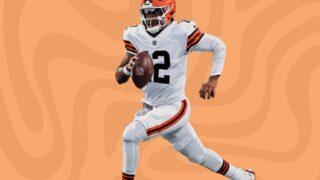
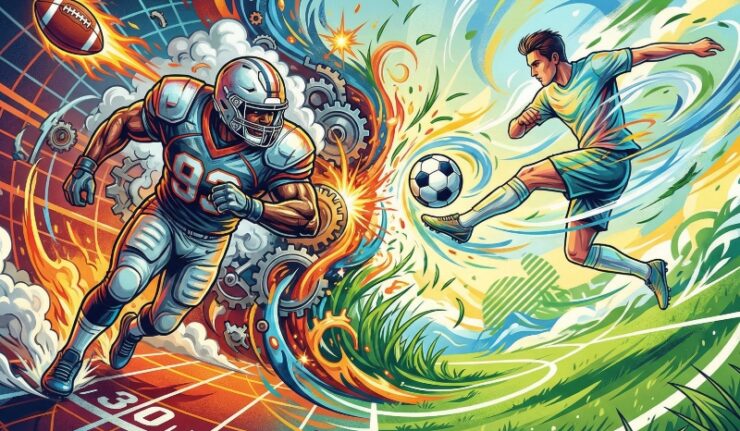
Depending on which side of the Atlantic you call home, this word either conjures images of lanky, cardiovascular demigods chasing a checkered sphere for ninety uninterrupted minutes, or armored behemoths colliding with the force of small SUVs in six-second bursts.
It is a linguistic custody battle that will never be resolved. The rest of the world calls it football because, well, you use your foot to hit the ball. Americans call their version football because… actually, nobody is entirely sure why. A quarterback uses his foot rarely, usually only to punt the ball away in disgust because his offense stalled. It should probably be called “Run-Throw-Smash-Ball,” but that doesn’t fit neatly on a jersey.
To understand these two distinct religions, we must move past the name and look at the scripture. The differences between American football and global soccer aren’t just rule variations; they are fundamentally opposing philosophies on time, space, and human collision.
The Physics of Contact vs. The Theater of Pain
The most immediate difference is the violence. American football is organized combat masquerading as a ball game. The players wear helmets and pads not as fashion statements, but because their job description involves being human ordinance. The sport is anaerobic. It is explosive. It is a series of scheduled car crashes punctuated by huddles where everyone catches their breath and agrees on who to hit next.
Soccer, conversely, is an aerobic nightmare. It is continuous flow. The contact is incidental, tactical, and often passive-aggressive. A soccer player is a gazelle; a football lineman is a rhinoceros wearing a flak jacket.
This leads to a distinct difference in how pain is processed. In the NFL, if a player’s femur snaps, they try to walk it off so the opposing coach doesn’t think they’re soft. In soccer, if a gust of wind hits a striker’s earlobe at the wrong angle in the penalty box, he drops to the turf clutching his shin as if shot by a high-caliber sniper, only to perform a miraculous resurrection thirty seconds later when the referee ignores him.
The Clock: A Tyrant vs. A Suggestion
The pacing is where the cultural divide truly widens. Soccer is fluid. The clock ticks upward, relentlessly, from 0 to 90. There are no commercials. You cannot leave the room to make a sandwich because that ninety-second window is inevitably when the only goal of the match will occur. It demands sustained attention.
American football treats time the way Salvador Dalí treated clocks—it’s meltable. A standard NFL game takes over three hours to play sixty minutes of “game time,” of which only about eleven minutes is actual action. The rest is strategic loitering, instant replay reviews where grown men stare at high-definition blades of grass to determine “possession,” and enough truck commercials to finance the GDP of a small nation.
Why It Matters: Improvisational Jazz vs. Military Strategy
Why do these differences matter? Because they reflect what we value in competition.
Soccer is improvisational jazz. There is a structure, but the beauty lies in the chaos, the sudden stroke of individual genius within the collective flow. It’s a game that accepts fate; sometimes you dominate possession for eighty-nine minutes and lose because the ball deflected off a defender’s buttocks. That is soccer. That is life.
American football is turn-based military strategy. It is rigid, calculated, and obsessed with control. Every single movement, every step a wide receiver takes, has been choreographed by a coaching staff that hasn’t slept since August. The playbooks resemble schematics for a nuclear submarine. We love it because it suggests that if we just prepare hard enough, if we just execute the scheme, we can conquer chaos through brute force and complex planning.
The legends of this highly specialized, strategic warfare are revered because they mastered distinct roles within that complex machine. If you want to dive deep into the titans who perfected these specific roles, you can browse through the history of Pro Football Hall of Fame players to see how the game’s greatest specialists are immortalized.
Ultimately, enjoying one doesn’t mean hating the other. We can appreciate the poetic stamina of a 1-0 soccer thriller and the armored chess match of a 24-21 NFL Sunday. Just don’t confuse the two. You shouldn’t bring a baguette to a cinderblock fight.
